Mason Community Arts Academy
Categories
Community Outreach Instruments in the Attic Music

Academy Receives Dale Earnhardt Foundation Award

Categories

We are thrilled to announce that the Academy has been honored with the Legend Leadership Award from the Dale Earnhardt Foundation, specifically for our Instruments in the Attic donation and outreach music program. The prestigious grant award continues the late great Dale Earnhardt’s commitment to supporting programs that focus on children, education, and environmental/ wildlife preservation.

The award includes a generous financial gift from the Dale Earnhardt Foundation, earmarked for expenses related to musical instrument repair and for scholarship funds for two Mason student “Teaching Scholars”, plus an official certificate, a book about Mr. Earnhardt, and finally a signed, limited edition Epiphone electric guitar (pictured above).


Dale Earnhardt Legend Leadership Award


“On behalf of the Dale Earnhardt Foundation, we would like to congratulate you, and the Instruments in the Attic program, as one of our selected Legend Leadership Award Winners,” stated Dale Earnhardt Foundation representative Rhonda Phipps in a letter to the Academy. “In recognition of this creative program, and the leadership of your [Mason] students, [the grant award will] help the program to continue and expand. Congratulations on all your achievements and we know that you, and Instruments in the Attic, will continue to make a positive impact with the students in your community through the universal gift of music.”

The Instruments in the Attic program accepts gently-used instruments from generous community members who no longer have need of them, but can’t bear the thought of throwing them away. As funding allows, the Academy repairs the instruments to playable condition (as necessary) and then places them in various school or community music programs and into the hands of deserving young students who might not otherwise be able to participate in the joy of music-making.

Through the Teaching Scholars program (also part of Instruments in the Attic), a select group of Mason School of Music students (often Music Education majors) are awarded scholarships based on academic achievement and passion for music education. These Teaching Scholars are sent to local schools in the community to provide auxiliary music classes for young students, as well as auxiliary support to the music teachers in those schools.


Academy staff with Dale Earnhardt guitar
(Academy staff with the Dale Earnhardt limited edition Epiphone guitar)


The financial award from the Dale Earnhardt Foundation will allow for more instruments to be repaired and “re-used”, and will increase the number of Teaching Scholar scholarship awards that can be given. The heightened exposure of the program will also provide long-term sustainable benefits.

We would like to give a very sincere thank you to the Dale Earnhardt Foundation, and the Earnhardt family, for recognizing our efforts to give access to quality music education and experiences to all community members, and for helping us “recycle” the love of music for all to enjoy!


Dale Earnhardt Foundation Logo
LEARN MORE ABOUT THE DALE EARNHARDT FOUNDATION


LEARN MORE ABOUT INSTRUMENTS IN THE ATTIC


Categories
Community Outreach Music

Piano Student Receives Special Recognition Award

Categories

This past spring, we were proud to present the 1st annual Vasya Georgieva Award for Artistic Excellence to Kristine Lowkis, a graduating senior studying piano with Academy faculty Faith Zúñiga. The new Vasya Georgieva Award was created by Academy faculty and board member, and Mason School of Music alumna, Dr. Ina Mirtcheva Blevins in honor of her late grandmother.

(Pictured above left to right: Faith Zuniga, Kristine Lowkis, Dr. Ina Mirtcheva Blevins)

Dr. Mirtcheva Blevins, who has been a part of the Academy faculty for over 8 years, approached the staff earlier this year with the idea and desire to not only honor her grandmother, whom she credits with helping to shape her love of music, but to also inspire and encourage the next generation of high school graduates to continue on to higher education, whether seeking a professional music career path or not. Along with the special recognition and certificate, the award winner will also receive a small financial gift to be put towards college tuition, funded by Dr. Ina and her family.


Ina Mirtcheva Blevins presents award


Open to graduating high school students who have consistently studied music at the Academy for a certain amount of time, applicants were given a basic questionnaire and asked to write an essay that described their love of music and their future goals. From that deserving cadre of students, Kristine Lowkis was chosen by the Award panel, which of course included Dr. Ina.

Kristine has studied piano with Ms. Zúñiga for just over a year, and she has applied and already been accepted to Mason! She will be studying Music Composition starting this Fall 2018, with piano as her primary instrument. Ms. Zúñiga writes, “I am impressed with how quickly she has improved her piano technique and performance skills since I began teaching her. Kristine has what it takes to reach her goal of becoming a film scorer, as she is not only a very focused and talented composer, but also has the entrepreneurial spirit necessary to achieve success as a musician.”

In fact, Kristine let us know that she has already worked locally as a composer! She recently worked with Centreville High School’s production of The Laramie Project.  “I enjoyed collaborating with the director and actors to help convey the heavy message using music. It was exciting to hear my music played in a large auditorium for a professional production,” Kristine said.


Award winner Lowkis performs


When asked when she first fell in love with piano, Kristine told us, “My first interaction with piano was when my church choir director allowed me to sit with him at the organ. As an organist assistant, I pulled levers, turned pages for the organist, and helped with other little tasks during the church service. Every Sunday, I watched him effortlessly sight-read piece after piece and unite a group of people through music. I aspired to be just like him and sounded out pieces on the piano like Billy Joel’s ‘Piano Man’ and Beethoven’s Für Elise.”

“This award has so much personal meaning to me and my family,” said Dr. Ina. “I’m so happy to be awarding such a deserving young musician!”

We are so grateful to have been part of Kristine’s musical journey up to this point and wish her all the best as she begins the next stage of her life as a Music major at Mason. Congratulations, Kristine!


LEARN MORE ABOUT PRIVATE MUSIC LESSONS AT THE ACADEMY


Categories
Community Outreach Instruments in the Attic

Academy Awarded Instrument Donation From D’Addario Foundation

Categories

We are happy to announce that the D’Addario Foundation has generously awarded the Academy’s Instruments in the Attic program with an in-kind donation of D’Addario musical instrument accessories in the amount of $500, which will be used in several music outreach programs that occur throughout the year, both in schools and beyond.

The Academy’s Instruments in the Attic program has been providing donated musical instruments to local school band and orchestra programs, community organizations, and even international initiatives for 10 years, with an ever-growing inventory of instruments collected from conscientious and music-loving community members like you.


Donated Musical Instrument Storage


The in-kind donation of musical instrument accessories from D’Addario Foundation will allow the Academy to keep the “recycled” instruments in top playing condition and will reduce the overhead costs of instrument repair involved in maintaining the outreach program.

The D’Addario Foundation is a unique non-profit grant-making organization providing monetary and product support to high-quality sustainable music instruction programs on the frontline to improve access to music education. The Foundation’s mission is to support programs that bring music back into communities and schools and get kids playing as early and as frequently as possible. The D’Addario Foundation believes in the transformative power of music and that mentoring and building communities through music can positively affect social change.


Daddario Foundation Logo


The Academy would like to extend a heartfelt “Thank You” to the D’Addario Foundation for the honor of this award, and for recognizing the valuable contribution that the Instruments in the Attic program is providing to our local community, region and beyond!


LEARN MORE ABOUT THE D’ADDARIO FOUNDATION


LEARN MORE ABOUT INSTRUMENTS IN THE ATTIC


Categories
Community Outreach Music

A Violin Story

Categories

WRITTEN BY CLAIRE ALLEN IN DECEMBER 2017

This is the story of a very special violin that began its life in a workshop in Scotland and currently resides in San José, Costa Rica in the hands of a gifted student. Its journey has taken it across the Atlantic Ocean, to our Instruments in the Attic supply room, through the workshop of luthier Jason Day, and briefly through my own hands as a violin teacher traveling to Central America to teach, play, and learn.

We know very little about about the origins of this particular violin. The existence of any violin in itself is a miracle – the creation of a single instrument takes weeks of labor, materials from all over the world, and techniques that took centuries to perfect. No label identifies the maker of our violin, just the words “Glasgow 1908” written on the inside of the instrument in pencil. We know two things: At some point, the instrument was severely damaged, and it was donated to Instruments in the Attic sometime within the last ten years.

Instruments in the Attic began as an outreach initiative for the George Mason University School of Music by J.P. Phaup in 2007 and was expanded by then assistant director of Potomac Arts Academy (former name of Mason Community Arts Academy), John Kilkenny. It has evolved into one of the farthest-reaching and most impactful parts of the Academy under Director Libby Curtis. It was therefore a natural addition to Mason’s new International Teaching Scholars program that brought GMU students and professors with Academy staff, faculty, and board members to San José, Costa Rica, this past spring.

Here’s where I enter (albeit briefly) the story of the Glasgow violin. When I joined the team heading to Costa Rica, it was decided that I would use one of our higher quality Instruments in the Attic violins to perform and teach while in San José. I would then leave the violin at one of the schools we visited for a student to use going forward. So, I paid a visit to Day Violins in Chantilly, Virginia shortly before my departure. Day Violins is owned by Jason and Jenna Day, who have donated countless hours of labor and materials to restore string instruments to playing condition for Instruments in the Attic. Jason let me try out various instruments in the collection before I selected the Glasgow violin to take to Costa Rica. He had completed several heavy repairs on the instrument in order to restore it to playing condition.

Jason writes, “The violin was in terrible disrepair when I got it. The top had several cracks in it and someone had decided to strip all the varnish off of the violin, which was a terrible shame. So, that [the varnish] was redone as well and antiqued to match the age of the violin. Literally, it was brought back from the brink!”

I took the violin home, continued practicing my Spanish, and began getting acquainted with the instrument. A week later, this 110-year-old Scottish violin and I boarded a plane bound for Costa Rica.


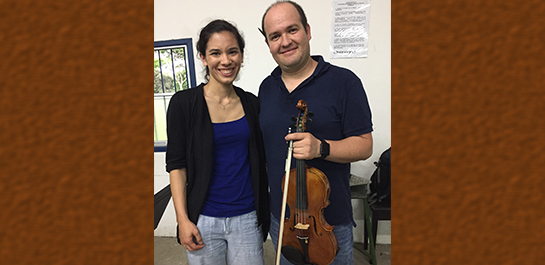
I wrote about my experiences over the summer (“Building Musical Relationships in Costa Rica”) with Jason and Jenna fixing instruments at Conservatorio de Castella, an arts magnet school in Heredia, some 30 minutes outside of downtown San José. My time spent there was the most significant experience of my visit to Costa Rica, and it was to this school that the Glasgow violin would be donated. I spent two days there fixing instruments with the Days, and returned for a third to visit a strings class taught by violinist Juan Carlos Martínez.

I had a wonderful time visiting Juan Carlos’s class. I took the Glasgow violin out of the case, wincing a bit at the humidity, and sat in with the first violin section. We played some fun pieces, including arrangements of songs by the Beatles. I laughed to realize that “¡No corre!” (“No running!”) was the correction given most frequently to the violin section. My own students hear me tell them not to rush on a weekly basis. It would seem that certain violinist traits transcend cultural boundaries.

I performed a short section of the Fiocco Allegro for the class, and then fielded questions from them about studying music in the United States, which tested the limits of my Spanish vocabulary! Luckily, Juan Carlos had studied at the Berklee School of Music in Boston and his English was much better than my Spanish, allowing him to translate for me when needed.


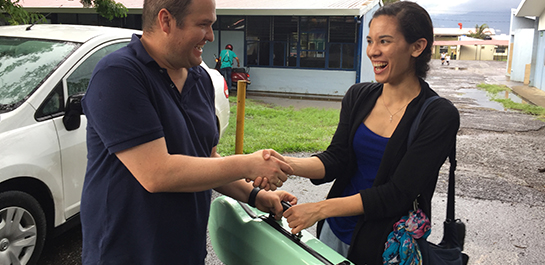
Violin donation to Costa Rica school


When I told Juan Carlos that the violin I had played on was in fact a donation from my organization to Conservatorio de Castella for a student to play, he was shocked and incredibly grateful. I told him that I understood the feeling, because one of my own private students plays on an instrument loaned to him by Instruments in the Attic that has transformed his life. We connected over how challenging it can be to teach an advanced student advanced repertoire when they don’t have access to a high-quality violin. The right instrument really does make all of the difference for these students. We also connected over our shared love of music, teaching, and our desire for our students to have access to every musical opportunity possible.

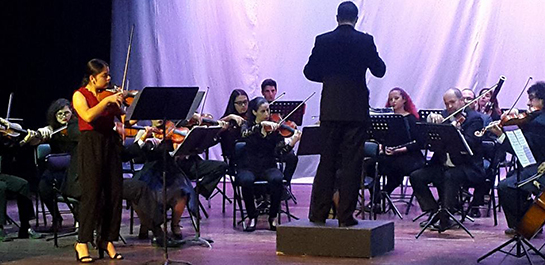
It’s been months since the Glasgow violin and I spent six short days in Costa Rica, but the story doesn’t end with me handing the violin to Juan Carlos and returning to the States. He and I recently exchanged emails in which he told me of the newest chapter in the life of the violin. He wrote, “El violín que donaron lo está tocando mi alumna Jimena Garita, ella fue escogida para tener el violín durante su último año de Colegio. Algo muy bonito es que este año ella ganó un concurso y el sábado anterior tocó la Romanza #2 de Beethoven con la Orquesta Sinfónica de nuestro Colegio. Ella ha tenido un gran avance con la ayuda del violín.” Translated roughly, this reads, “The violin that was donated is played by my student Jimena Garita. She was chosen to have the violin for her last year at school. Something very beautiful is that this year, she won a competition and last Saturday played the Romance No. 2 by Beethoven with the Symphonic Orchestra of our school. She has had a great advance [in her playing] with the help of the violin.” Juan Carlos was also kind enough to provide a photo of Jimena performing (pictured below).


Jimena Garita performing with donated violin


The existence of a violin is a miracle in itself. The journey of a completed violin can lead to a unique brand of musical diplomacy and create social change in the communities it passes through. And the effect a violin can have in the hands of a musician who loves it is impossible to measure by any standard. It’s my hope that the Glasgow violin continues to transform Jimena’s life, as well as the lives of any Castella students after her who are so fortunate as to play it.

Many thanks to Elizabeth Curtis, Jason Day, Carlos Valverde Infante, and Juan Carlos Martínez for providing information for this post.


Categories
Community Outreach Music

Music Teaching Scholars Help Out At Local Schools

Categories

Each school year, the Academy coordinates a Teaching Scholars program with Mason’s School of Music, selecting qualified Music students and matching them with local schools to provide in-school augmented music instruction and supplemental study to children in Grades 4-8 who would otherwise not have access to such resources.

This year, 5 Mason Music students – many of which are Music Education majors – received Teaching Scholar awards, and from November through May traveled to Woodburn Elementary (Falls Church, VA), Cunningham Park Elementary (Vienna, VA) and Rippon Middle School (Woodbridge, VA), working with approximately 70 public school students.


Community outreach music program


Once a week, students receive one hour of music instruction from the Scholars. For many students, musical instruments were also loaned out through the Academy’s Instruments in the Attic program. The Teaching Scholars coordinated with a teacher/ teachers from the school to maximize the musical and educational impact.

A wonderful additional benefit of the program is that it provides an opportunity for  Mason Music Education students to gain crucial real-world teaching experience while still pursuing their degree.


After school music program


“I chose Mason because of its fantastic instrumental professors and education program,” said Mason music major Glenn Turner. “The Teaching Scholar award that I received will help me immensely on my road to graduation, and also ensures that I will be a stronger, more experienced teacher when I do earn my degree.”

The Academy’s ability to provide this outreach program to the community depends in part on donations from generous community members like you. Please consider making a gift to help us reach more kids!


LEARN MORE ABOUT OUR TEACHING SCHOLARS PROGRAM