Mason Community Arts Academy
Categories
Music

Faculty Feature: Masha Feygelson

Categories

Masha Feygelson is a member of our Piano faculty at the Academy, with many adoring students in her studio. You may be surprised to know that she is also a jazz singer, with a Valentine’s Day themed performance coming up on Saturday, February 10th. Learn more about this talented musician in her interview with our Faculty Coordinator Claire Allen.


CAllen: What’s your favorite part about teaching for the Academy?

MFeygelson: What begins as a simple inquiry with our office about piano lessons, grows into such an enriching learning process and human connection. I’ve met and worked with so many lovely people…it’s really a gift to get to know our community through the unique lens of being a music teacher.


CAllen: How did you first fall in love with music?

MFeygelson: I don’t think there was necessarily an epiphany; being in love with music has been a state of being since earliest childhood. My mother realized this and took me to music classes very early on. Even as a three year old, I walked around singing endlessly. Not much has changed!


CAllen: Tell us about a teaching experience you had that was especially memorable.

MFeygelson: So, so many…it’s impossible to choose. As any teacher will tell you, every day with children is full of hilarious comments and questions and discoveries…and there are a thousand little triumphs along the way.


Masha Fegyelson, Jazz singer


CAllen: What are some unique things you do when you teach?

MFeygelson: There’s certainly nothing new under the sun, but one thing I always do is encourage my students to sing! With young beginners, we might make up lyrics to accompany their pieces or imagine scenes and stories that could be set to the music. It is extremely helpful for pianists of all ages and levels to sing note names while practicing – vocalizing musical lines helps in building beautiful phrases and aids memorization.


CAllen: Do you have any pets? If so, tell us about them. If not, tell us the type of pet you would like to have.

MFeygelson: My closest brush with being a pet owner was about a month ago, when a field mouse was loose in my apartment for a few days, after I tried to domesticate her…I was sad to see her go, but honestly, it probably wouldn’t have worked out. The truth is, I adore animals and would gladly house everyone from rats to cats to lizards – once I live somewhere that can comfortably house all of us. #TeamCat #TeamDog #TeamAnimal


CAllen: What else would you like our community to know about you?

MFeygelson: Singing is my other musical passion – mostly jazz and pop. After finishing grad school last spring, I can finally dedicate more time to vocal studies and performances. I’m very excited for my first full solo concert on February 10th!
SEE FEBRUARY 10TH PERFORMANCE FLIER


SEE MASHA’S BIO

LEARN  MORE ABOUT PRIVATE LESSSONS


Categories
Art Community Outreach Events Music

Musical Instrument Sculpture Project Gets Buzz

Categories

WRITTEN BY ZACHARY WILCOX

In 2008, Mason Community Arts Academy (“MCAA”, formerly known as Potomac Arts Academy) started a green initiative and outreach program named “Instruments in the Attic”. This program takes in old & unused musical instruments donated by generous community members with the idea of bringing as many as possible back to working order for deserving students of all ages to enjoy and play for years to come. Since its creation, Instruments in the Attic has brought in over 850 instruments, returning many back to the community for further use… but not all instruments are able to be repaired. One of the primary goals of the program is to keep these instruments out of the landfill, so we needed to find another green solution for these irreparable instruments.

MCAA thought about how to recycle these instruments in a more artistic and meaningful way, which sparked an idea to collaborate with the Patriot Green Fund (part of Mason’s Office of Sustainability) and Mason’s School of Art. We figured that these instruments could be “up-cycled” into sculpture art projects which told a story, powered by a STEAM approach. School of Art Associate Professor Edgar Endress had an even more innovative idea. He invited Dr. Daniel Lofaro from the Volgenau School of Engineering to assist him in constructing an orchestra of automated sound sculptures using new (and old) media technology balanced with influences of 20th century Russian Constructivist art , amongst other styles, forms, and ideas. Special funding from the Patriot Green Fund helped to facilitate this unique undertaking.


Musical Instrument Sculpture


EVENT: Come and see the “Narrative Machine” sculpture prototypes on display
Overall, this is a long-term project involving several steps. However, the fruits of step one are complete! The sculpture prototypes of this data-fueled, artistic adventure are currently on display in Mason’s Center for the Arts Lobby through mid-February.

The exhibit is getting a lot of buzz, with articles already included in the Center for the Arts newsletter and featured on Mason’s newsletter The George, plus an upcoming article in Mason’s Office of Sustainability newsletter. Read the articles below to learn more, and come interact with these instruments – be a part of “The Narrative Machine”!


SEE ARTICLE FROM THE GEORGE


SEE ARTICLE FROM CENTER FOR THE ARTS


Categories
Music

Faculty Feature: Amy Lenk

Categories

Amy Lenk is the newest member of our flute faculty! She joined the Academy as a Teaching Artist last summer and is new to the area. Faculty Coordinator Claire Allen sat down with Amy to learn more about her music and her teaching!


CAllen: What excites you the most about joining the music faculty at the Academy?

ALenk: I’m excited to meet new students and to be part of a thriving arts community!


CAllen: How did you first fall in love with music?

ALenk: My family is very musical. I grew up with piano, harp, violin, clarinet, cello, singing and flute in the house. So my love of music began through the musical nurture my parents and older sister fostered. Playing in youth symphony in high school is what really caused me to fall in love with music. Playing in an orchestra makes you feel as though you have a part in something much bigger than yourself and it’s a powerful experience!


CAllen: Tell us about a teaching experience you had that was especially memorable.

ALenk: Most memorable for me is hearing my students perform in recitals. I always feel like I could burst with pride!


A flute


CAllen: What are some unique things you do when you teach?

ALenk: I like to inspire curiosity in students. I show by example and ask lots of questions to get them listening and thinking about how to improve whatever aspect of flute playing we are working on. This engages the student and encourages them to take ownership of their development more than if I were to spoon-feed them all the answers. I also use a lot of food metaphors, because I love food! [laughs]


CAllen: Do you have any pets? If so, tell us about them. If not, tell us the type of pet you would like to have.

ALenk: I don’t have any pets now, but I love dogs! #Teamdog


CAllen: What else would you like our community to know about you?

ALenk: Just that I love playing the flute and it’s hard to imagine anything more fulfilling than seeing that love grow in my students!


SEE AMY LENK’S BIO


LEARN MORE ABOUT PRIVATE LESSONS


Categories
Music

Faculty Feature: Brian Slaymaker

Categories

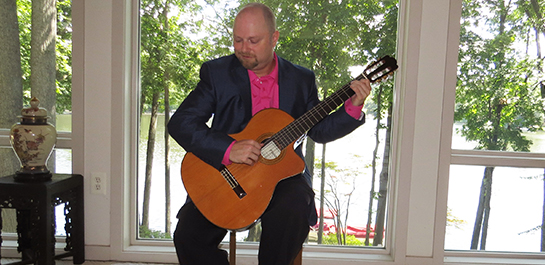
The Academy is excited to welcome Teaching Artist Brian Slaymaker to our Guitar faculty this fall! Brian is an alumnus of George Mason University and is thrilled to rejoin the Mason community as a teacher. Faculty Coordinator Claire Allen sat down with Brian to learn more about him and his teaching.


CAllen: What excites you the most about joining the music faculty at the Academy?

BSlaymaker: Teaching at an institution that is affiliated with George Mason’s School of music is exciting. I learned so much as a Music Major at GMU, and now it’s an honor to be employed as a teacher by the Potomac Arts Academy.


CAllen: How did you first fall in love with music?

BSlaymaker:  I remember when I was about 6 years old how thrilled I’d get when my mother would play the “Stars Wars” theme song on the piano for me. I asked her to play it over and over!


CAllen: Tell me about a teaching experience you had that was especially memorable.

BSlaymaker: Watching my first student recital was a surreal experience. I couldn’t believe that those young students started as beginners, and they played fantasticly. I almost cried. I’m glad I didn’t! [laughs]  


CAllen: What are some unique things you do when you teach?

BSlaymaker: I’m not sure how unique some of the many things are that I do. I like to break the routine. Lessons can become redundant with the same methods and the same procedures. My students are always shocked when I say, “Let’s do something totally new instead”. Sometimes younger students say, “But we’re not supposed to do that!”.


CAllen: Do you have any pets?

BSlaymaker: I have a cat (domestic short-haired) named Jill. She had a partner named Jack, but he passed away. Since then Jill has become very strong willed –  and a leader. #TeamCat


CAllen: What else would you like our community to know about you?

BSlaymaker: I’ve had 4 careers: I was a cook, then a bicycle messenger, then a carpenter, and now a musician. I’ve built houses from the foundation all the way through the roof. I know what hard work is. I took a risk to launch my music career. It has paid off like I never thought possible. I’ve completely dedicated my life to music, and I love it!


READ BRIAN’S BIO


Categories
Music

Teaching Artist Glen McCarthy Talks Guitars

Categories

Academy Teaching Artist and Mason School of Music Guitar professor Glen McCarthy wants to know “Why aren’t you playing guitar?” He says that you just need the right tools. He was recognized in 2014 from over 32,000 nominees by the Grammy Foundation as one of the Top Ten Music Educators in the United States, so yeah, he knows what he’s talking about!

So why should you take guitar?
“I’d like to think that having me as your teacher would be a major influence in your decision,” says Glen. “My teaching experience includes instructing elementary school children to senior citizens. I teach privately, in the classroom, and conduct professional workshops nationwide as well as internationally. My approach is simple. What do you want to play? I will do my best to give you the tools to master that song. From strumming chords to playing a finger-style solo all styles are welcome.”

What’s the best type of guitar?
“No matter what, the best guitar for a beginner to use is a classic or nylon-stringed guitar,” Glen declares. “The strings are much easier on your fingers than a steel-stringed guitar. Note that three of the six nylon strings appear to be metal, but they have a nylon-filament core. All genres of music can be played on a classic guitar.”

What if you inherited a steel string guitar?
“If you have to use a steel-stringed guitar, your fingers will soon become sore and tired during their lessons and practice,” warns Glen. “The worst culprits are the high E and B strings that are a single strand of steel, contributing most to the ‘ouch’ factor. There are ways to deal with this. You may choose ‘extra-light gauge’ steel strings. They aren’t as loud, but they are easier on the fingertips. Another type of string is the hybrid ‘silk and steel’. Yes, it is perfectly okay to put nylon strings on a steel-stringed guitar, but not vice versa. Some steel string guitars may require a little filing of the nut to gain a good fit for nylon strings. Other adjustments may be beneficial too. Never put steel strings on guitar made for nylon strings. The stress on the neck is too much for a guitar made for nylon strings.”

What if you want to play steel string?
“If you prefer to play on steel string, that’s great,” Glen says encouragingly. “Traditionally steel string guitars are played with a pick, where classic guitars are played with fingers. ‘Rules are made to be broken’, as they say. Willie Nelson uses a classic guitar and plays it using a pick. ‘Dust in the Wind’, a popular song by Kansas, is played on a steel string using fingerpicking. Just realize that you’ll have to build up some callouses on those finger tips when you play a steel string!”


Diagram of guitar parts


What’s the best guitar size and construction?
“Manufacturers make guitars in a variety of sizes. They are ergonomically designed to be comfortable in the arms of students of all ages. Less expensive entry-level guitars of good quality are made with laminates that are able to tolerate temperature and humidity changes. Some have a shiny, lacquer finish; some have a dull, satin finish. Choose according to your taste and budget. The action (height of the strings over the fingerboard) should be consistent up and down the entire length. Are the metal frets comfortable with no sharp edges? Put your hand around the neck and move up and down to make sure. Do the tuners adjust easily? Tune the guitar and try some open chords. Does the instrument stay in tune? Play up and down the neck to make sure it plays in tune. Examine the interior to see seams and braces with no excess glue.”

What is the first step?
“If all this seems confusing, go to your local ‘brick and mortar’ store,” says Glen. “I recommend you use a store that has numerous guitars at various price points. Using the suggestions above, preview different brands of guitars with a sales associate.”

What else will you need?
“A padded ‘gig’ bag or ‘hard-shell’ case is recommended. Other items to consider purchasing include a music stand, foot-rest or other type of guitar support, tuner, capo, metronome, and guitar stand. In the winter when it’s extremely cold/dry you should have a humidifier in your guitar or case.”


“I guarantee – with the right tools, playing guitar is a ‘piece of cake’!” exclaims Glen. Along with teaching group guitar classes, Glen teaches private guitar lessons for the Academy.


READ GLEN’S BIO HERE