Mason Community Arts Academy
Categories
Art Community Outreach

Art Students Donate Artwork to Fairfax CASA

Categories

At the end of our Spring 2017 semester, students from our Visual Art classes volunteered to donate some of their created artwork to the local organization Fairfax CASA, which advocates for children who find themselves in the court system. The donated pieces of art have been framed and displayed in the Fairfax CASA office, where the children they assist can see them and be inspired.

Emily Rea, Supervisor for Fairfax CASA – which stands for Fairfax Court Appointed Special Advocates – said, “I just wanted to send along photos of the artwork which has finally all been framed! It looks beautiful in our office and we are very thankful. Thank you and the kids again!” She collaborated with staff member Candy Neukam from the Academy office to make the artwork donation possible. And our art students were more than happy to contribute!


Donated student artwork


Fairfax CASA Mission Statement
The mission of Fairfax CASA is to advocate for the best interests of each abused and neglected child referred by the Fairfax County Juvenile & Domestic Relations District Court through the promotion and support of quality volunteer representation.
We seek to ensure that each child’s needs are identified and addressed with the goal of living in a safe and permanent home. As permitted by our legislative charter, we also provide assistance to youths entering adulthood who have been referred to the CASA program by the Court, up to the age of 21.


Donated student artwork


The Fairfax Court Appointed Special Advocates (CASA) program was founded in 1989 by a group of community-minded Fairfax County citizens responding to a request for a CASA program from the Fairfax County Juvenile & Domestic Relations District Court (Court). Since that time, Fairfax CASA has operated as a 501(c)(3) public charity accepting support from individuals, corporations, and public funds to ensure that children who are victims of abuse and neglect are placed in safe and permanent homes as quickly as possible. This purpose is accomplished by recruiting, training, and supervising community volunteers to serve as special advocates for children whose families have been cited for abuse and neglect by the Court. It is the driving goal of Fairfax CASA to ensure that the best interests of all children referred by a judge are represented before the Court. Since its founding, Fairfax CASA has recruited and trained nearly 1,800 CASA volunteers to provide this critical service to more than 6,700 children who have been referred by the Court.


Donated student artwork


We hope to be able to provide inspiration and hope again in the future through artwork created by our very own students!


Fairfax CASA Logo

LEARN MORE ABOUT FAIRFAX CASA


SEE OUR VISUAL ART CLASSES


Categories
Community Outreach Music

Building Musical Relationships in Costa Rica

Categories

Last month, I (Claire Allen) accompanied George Mason University School of Music’s International Teaching Scholars and their professors on a trip to Costa Rica. This was a multi-faceted trip, designed to allow participants to fully experience the country’s culture, study and perform alongside professional musicians, teach and conduct university students in Costa Rica, and to learn about music education at every stage – from after-school elementary programs in the rougher neighborhoods of San Jose to masterclasses at the collegiate level.

Potomac Arts Academy’s outreach program, Instruments in the Attic, was one of the sponsors of this trip. Fifty donated instruments, all with special notes inside from young Academy students, were sent through the Costa Rican embassy to be used in SINEM music education programs.

In addition to donating instruments from the Instruments in the Attic inventory, we were joined by Jason and Jenna Day of Day Violins for three days to visit Conservatorio Castella, an arts magnet school just outside San Jose, to repair string instruments. The Days arrived with three suitcases full of instrument parts, glue, and all types of tools. We made a brief visit to Conservatorio Castella on Monday to see how many instruments were in need of repair. We were led to the Bodega de Instrumentos, a large room where the school stored instruments for the use of the students.


Sign reading Bodega de Instrumentos


Violins, violas, cellos, and a few upright basses were arrayed on the shelves. Some of the instruments were in cases; many were not. Very few of the instruments were in usable condition. We would later learn that most of the playable instruments were currently in possession of the students. Dust caked the instruments, which were in various states of disrepair. Most of them were missing some combination of strings, bridges, tuning pegs, soundposts, and tailpieces. In some extreme cases, the scrolls or necks of the instruments had totally broken away from the bodies.

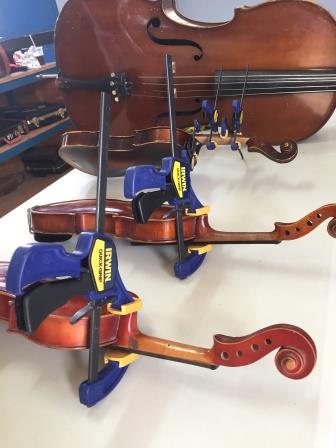
The most damaged instruments were immediately handed over to Jason, who glued and clamped cracks, seams, and severed necks. These were left to dry overnight. In a building without air conditioning, in a humid climate, allowing enough time for the glue to dry was essential.


String instruments being repaired


We also did our best to assess how many instruments were in need of repair and to create a plan of attack for the following day. Walking into the room and seeing all the broken instruments was overwhelming. Thinking of children who wanted to learn music but couldn’t because they didn’t have a usable instrument was gut-wrenching, and we fought back tears more than once as we took on the task before us.

On Tuesday morning, Jason, Jenna, and I arrived at 7:15 am to begin work. We laid out as many instruments as would fit on the counter and got to work. I had to overcome some of my natural aversion to attempting instrument repairs on my own – the goal was to make these instruments playable and so they would make a sound while holding together. I frequently asked Jason to check my work to make sure I wasn’t making any mistakes! We also had to overcome our scruples and take functioning parts from instruments we judged were beyond our ability to repair.


String instruments being repaired


The first step was to clean off the layers of dirt and dust that covered the instruments. Jenna used wood pens to do cosmetic repairs on the many nicks and scratches that marred the varnish of each instrument. I fitted each instrument with new pegs, tailpieces, chin rests, and strings. The heaviest and most specialized repairs we left to Jason, the professional luthier. He cut new bridges, re-set (or made new) soundposts, and glued seams and cracks, among many other repairs!


Jason Day and Claire Allen repairing instruments


Helping us with the repairs were Carlos and Victor, two teachers at Conservatorio Castella who manage the instrument room. As wind and brass players, they hadn’t had much experience with string instruments, let alone repairs, but they were eager to learn. We learned that for various reasons, it is extremely difficult and prohibitively expensive to complete even the most basic string instrument repairs in Costa Rica. Once Jason realized they wanted to help and learn, he started teaching them how to fix instruments then and there. Thus began an exciting conversation that lasted the entire day and switched between Spanish and English. Jenna and Carlos were both fluent in Spanish and English and served as translators. My Spanish is fairly functional, as a result of studying it in school, but I’m by no means fluent. Victor’s English was slightly worse than my Spanish, and Jason only knew a few words and phrases in Spanish. Thanks to the varying levels of language proficiency among our group, we were able not only to work together but to learn about each other’s lives and musical experiences. In addition to discussing instrument repairs, we also traded fun musical stories about performances we had been a part of, teaching students who didn’t want to practice, and experiences at summer music festivals. Carlos and I had an unexpected conversation about Omaha, Nebraska, where he had attended marching band camp, and where my mother was born!


Team in Costa Rica repairing instruments


Some of my favorite Spanish words and phrases that I learned over my week in Costa Rica were learned that day in the Bodega de Instrumentos. Among them are “estrella de muerte,” or “Death Star.” When Victor walked into the room wearing a Star Wars t-shirt that morning, I greeted him with, “Victor! Somos amigos. Me encanta Star Wars!” Anyone who knows me knows just how much I love Star Wars and what a huge fan I am. It was an instant connection between us. I was so excited to talk about my favorite movies in Spanish – and it was affirming to know that my passion for Star Wars can make me friends even when I’m far away from home.

My other new favorite word is “alma,” which means “soul.” “Alma” is also the word used to refer to the soundpost, or the piece of dowel inside a string instrument that helps support the top of the violin as well as transferring vibrations between the front and back plates of the instrument. The placement of the soundpost is crucial for the tone of the instrument. Moving it even a few millimeters can completely change the sound. So, when I learned that the words for soundpost and soul in Spanish are one and the same, I realized that many of the instruments we were repairing were without soundposts – without souls. This broke my heart and I was relieved and grateful that Jason had brought extra dowels with him so he could give these instruments back their souls as we restored them to playing condition.

By early afternoon, word had spread on campus that we were there, fixing instruments. The rest of our group from Mason had also arrived and helped us clean instruments for an hour before they went to teach and play with the school’s band. The Bodega de los Instrumentos was suddenly full of people. We met just about every teacher on faculty (yes, Victor did introduce me as the girl who likes Star Wars), who came to thank us for the work and specify needed repairs on their students’ instruments. This kicked us into overdrive, since we weren’t yet finished with the instruments that were already in line to be fixed! Thanks to our team and the system we had worked out, we were able to complete all of the repairs, even with the extra instruments added in. When we left at 5 pm, we were exhausted but had fixed 32 violins and violas, 10 cellos, and 2 basses. Carlos and Victor had learned a lot about fixing string instruments – so much, in fact, that Jason left all of his tools, including the electric sander and drill, and most of the spare parts for them to use in the future.


Repaired string instruments


Helping to fix all those instruments was a monumental experience all in itself – but it’s the friendships forged among the five of us that day that made it one I will never forget. Both in my teaching and traveling, I’ve found that what matters the most to me in the world is creating authentic connection. True connection removes the divisions of “us” and “them,” especially when encountering people from different cultures than ourselves, and simply allows us to be human beings in relationship with each other. I have come to realize that many of the deepest connections created between souls (or “almas”) are ones that share a love of music and the arts. Whether it’s working toward a common goal like fixing an entire room full of broken instruments, sharing stories about our own experiences with music, or discovering a mutual love for Star Wars, it is the relationships built between people that truly make a difference in our world.


Team in Costa Rica repairing instruments


Learn more about our International Teaching Scholars program, Instruments in the Attic, and other OUTREACH PROGRAMS.


Categories
Music

Faculty Feature: Zachary Whitaker

Categories

Zachary Whitaker is one of the newest members of our string faculty and is building a private cello studio in addition to his work as a chamber coach and a member of the Faculty String Quartet. Faculty Coordinator Claire Allen sat down to learn more about Mr. Whitaker and his cello playing.


CAllen: How long have you taught at Potomac Arts Academy?

ZWhitaker: About six months.


CAllen: What is special about working for the Academy?

ZWhitaker: Potomac is special because the staff put the growth and development of the students first. Since I’ve been at Potomac, there have already been efforts to create friendly competitions for the students, to add classes to the curriculum, and free concerts have been given to showcase the teachers whom the students work with.


CAllen: How did you first fall in love with music?

ZWhitaker: When I was a freshman in high school, we were all given the opportunity in orchestra to advance our seating by “challenging” the next highest seated player to a playing test. I began that year as last chair out of about seven, and ended up second chair by the end of the year. The drive to become as proficient as these upperclassmen helped me to understand and to appreciate the factors which make music so enjoyable to play and listen to.


CAllen: Tell me about a teaching experience you had which was especially memorable.

ZWhitaker: It wasn’t so much a teaching experience as a teaching outcome, but one of the proudest moments I had was watching a student of mine play the Vivaldi C minor Cello Concerto with their youth orchestra, which happened to have been the same youth orchestra that I had played in while in high school. We had worked together on the piece for some time, and all of this student’s efforts and determination came together in a truly excellent performance.


CAllen: What are some unique things you do when you teach?

ZWhitaker:  I don’t know if anything I do is truly “unique”, though maybe it’d be considered such to someone who has not witnessed many music lessons. I’ve danced for students, I’ve had students dance… I have students come up with stories to their music, I have students sing their parts, I’ve had students compose music which we then play together, I’ve accompanied students on the piano, I’ve hopped up and down to the beat for students. I also tell my students to relate aspects of cello technique to bouncing a basketball, which some might find unconventional.


CAllen: Do you have any pets?

ZWhitaker: My family has a cat named Tiggur, who is an eight year old black Persian. He is proud, sassy, and he always finds his way into shenanigans.


Image of a cello


You can hear Mr. Whitaker perform in his upcoming Master’s Recital on Sunday, April 23 at 5 pm. The recital is at Vienna Baptist Church: 541 Marshall Rd., SW, Vienna, VA 22180. See Map

In our Fall 2017 semester, Mr. Whitaker will also be teaching a Beginning Cello Class for young students ages 4-7, as he completes his Master’s degree in Cello Performance and Pedagogy at George Mason University. Young students (and parents) interested in exploring the idea of cello playing can sign up for our Summer Music Sampler which includes a day of cello introduction by Mr. Whitaker!


SEE ZACHARY WHITAKER’S BIO


Categories
Community Outreach Music

Birthday Girl Gifts Love of Music

Categories

Birthdays are a great time to enjoy receiving gifts and celebrating with family and friends. For one special young girl named Sophie, turning 7 meant inviting friends to a fun-filled party and asking them to bring musical instrument donations!

Sophie’s mom said that their family has established a tradition of requesting donations for a good cause in lieu of presents for birthdays. When she learned of Sophie’s desire to follow that tradition for her 7th birthday, she began searching around for ideas. Fortunately for us, she came across our Instruments in the Attic outreach program, where gently used musical instruments are donated by community members, and the Academy finds ways and means to repair or refurbish the instruments as needed, and gets them into the hands of underserved students.

“The idea that our donated musical instruments would help provide musical opportunities for kids with little to no music education access really drew me in,” said Sophie’s mom, “Plus, Sophie loves the ‘School of Rock’ show and music in general.” In fact, Sophie’s birthday party had a “School of Rock” theme!

Sophie’s mom called the Academy to share their idea, and staff member Candy Neukam guided them on types of instruments to suggest. After a festive birthday party with 12 friends, Sophie and her mom came in with 4 bags of Early Childhood instruments, including bongos, finger cymbals, hand bells and more!

When Ms. Neukam asked Sophie what her friends thought of the idea, she said “They thought it was cool.” Sophie’s mom also mentioned that the Guitar Center offered discounts to the birthday party kids to encourage their efforts. We at the Academy think this is pretty cool, too! Thanks to Sophie, her mom, and everyone involved for making such a generous, thoughtful donation and for spreading the love of music to the community.


LEARN MORE ABOUT OUR OUTREACH PROGRAMS


Categories
Announcements Music

Guitar Student Wins Award at Competition

Categories

Zani Xu, student of Guitar Teaching Artist Chris Jenkins, recently placed 3rd in his division at the “Beatty Music Scholarship Competition for Classical Guitar” in Washington, D.C. Congratulations Zani, well done!

The “Beatty Music Scholarship Competition for Classical Guitar”  , underwritten by John and Susie Beatty, began in 2007 with the intention to celebrate and encourage young musicians in the Washington, D.C. metropolitan area.

Watch the video of Zani’s competition performance below. You might need to turn up the volume a little to hear the audio! (Video footage provided by Zani’s parents.)


We are very proud of Zani for his accomplishments, and to Chris Jenkins for being such a great teacher!

READ CHRIS JENKIN’S BIO