Mason Community Arts Academy
Categories
Announcements Community Outreach Music

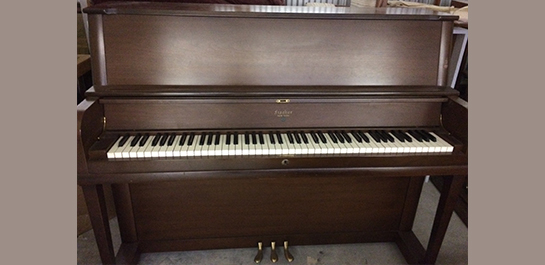
Piano Available To Good Home

A generous community member from the Fairfax area recently called the Academy about donating her acoustic upright piano to a good home. If anyone is interested in accepting this donation, please contact us asap.

The piano (pictured above) is a Fisher acoustic upright. The piano itself would be free of charge (to a good home); however, the recipient is required to pay for the moving expense, which averages $300-$500 (when using a professional piano moving company) depending on the distance traveled, number of stairs involved, etc. Also, acoustic pianos usually require a tuning from a professional piano tuner after a move as well.

If you think you have a need (and a space) for this piano, it’s a great opportunity to look into. As per usual, we will handle this on a first-come, first-serve basis. Please email us at [email protected]  (no phone calls please).
Categories
Announcements

Celebrating 10 Years: Mary Lechter

Mary Lechter is the Associate Director of Mason Community Arts Academy, which is celebrating 10 years, and she is the creator and director of Acting For Young People (the Academy’s theater division), which recently celebrated 20 successful years! Needless to say, she’s a cornerstone of the organization – staff member Claire Allen recently asked her to share some of her many experiences with us.


CAllen: How did you first become interested in/involved with the arts?

MLechter: When I was a kid, I suppose you could say I lived in my own MGM musical. I was Dorothy Gale from Kansas. I was a weird little kid. But I’m grateful for that now because I know it’s at the heart of why I do what I do. At that time, there wasn’t the abundance of enrichment programs that we have today or if they were there, they weren’t easy to find. So, I created my own. Much to the chagrin of my neighborhood friends, I roped them into coming to my “ballet school” or being in my annual production of the Wizard of Oz, that coincidentally I produced, directed and starred in. But what I realize now is that I had created a safe, creative place, for myself – and for any of those kids who were still talking to me! Once I finally found organized activities, I participated in theater, choir and madrigals throughout my teens, and majored in Theater at University of Maryland.


CAllen: What inspired you to create Acting for Young People (AFYP)?

MLechter: I was very fortunate to start my teaching career with two incredible organizations in Washington, DC: The Studio Theatre Acting Conservatory and The John F. Kennedy Center for the Performing Arts. At Studio, I helped create programs for their young peoples’ division. I learned a tremendous amount during that time, and count those as some of the most formative experiences I’ve had. When my husband Kevin and I moved to the Fairfax area, I realized that while there were some programs offered, there was still room for more professional-level training, and I was able to create my own curricula and start testing the waters for what types of programs would work well in the area. My first class was held at the Fire Station on University Drive in Fairfax City, and from there, we had a very nomadic existence for several years! We held classes in two different churches, empty retail spaces, and for a while, I used a dance studio in Springfield, bartering as an acting coach for their competition teams in exchange for use of the space when classes weren’t being held. Having a consistent place to call home [i.e. the Academy], to teach and work from regularly, has made a huge difference, and has allowed us to focus more on teaching and less on schlepping! But seriously, it has given us a sense of stability that has allowed our programs to flourish.


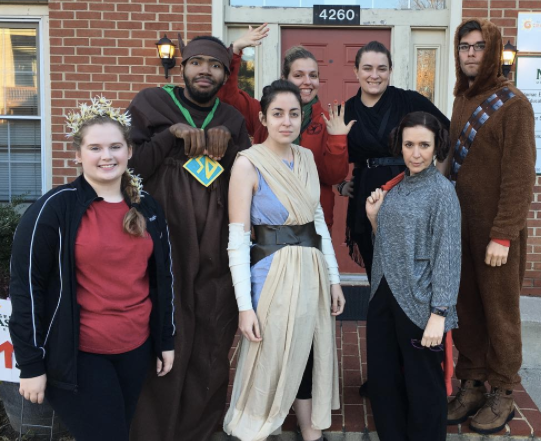
Mary Lechter with AFYP staff


CAllen: AFYP is obviously a spectacular program all on its own. What motivated you to first partner with and then become a part of Mason Community Arts Academy (MCAA)?

MLechter: Thanks to the support of then-Interim Dean Rick Davis, who saw the value of bringing hundreds of community members to campus each summer, we worked out a rental agreement and began offering our Summer Acting Camp at Mason in 2002. It was a huge game changer to be able to work in these spaces, and expand our camp staff to include more Mason students and grads. AFYP was growing exponentially each year, adding more and more after school programs, Saturday classes, and special workshops. When Libby Curtis took on the task of formalizing programming for the Mason Community Arts Academy (then known as the Potomac Arts Academy), she and I began exploring the possibilities of joining forces, starting with our summer programs. I feel so fortunate to work with Libby, and to have developed a wonderful friendship in the process. Bringing two organizations together has many challenges, but many more benefits, and tremendous growth has been possible thanks to our working together.


Mary Lechter with MCAA Staff


CAllen: What is your favorite part of your job, currently?

MLechter: There are so many things to love about my job, which is a bit of a hybrid, between serving as Associate Director of the Academy and overseeing our theater programs, teaching for the School of Theater at the University, and running AFYP’s original non-profit organization. The common thread is that I get to work with extraordinary people every day. I could not ask for better colleagues, a better staff, a better team of teaching artists, or more wonderful students and parents. I love that I get to learn from them in every aspect of what we do. Of course, having the privilege of watching our students grow as artists and people, in big and small ways, is the ultimate perk of the job!


CAllen: Talk to me about AFYP and your initial goals for the program, and where it is currently. Did you expect it to grow in the way it did? What did you expect, and what has surprised you?

MLechter: Initially, when I began in 1997, I really wasn’t sure if this was going to go anywhere or what to expect, I just focused on the goal of reaching as many students and families as possible, and took my cues from the response I got. Those responses allowed me to make an informed business plan and grow it over years. I always say, I have had several “angels” along the way, including the City of Fairfax Commission on the Arts, who informally adopted our program in 1999, and allowed us access to classroom spaces in those early days. I remember for the first year of our summer camp, I just wanted 75 students over the three weeks of our half-day program in three small rooms at Fairfax High School, and we had about double that! There have been many more angels along the way, that have shared their expertise and helped build our programs. This past June AFYP marked its 20th anniversary with a beautiful celebration, and I was extremely moved that some of our very first students and teachers had traveled from various parts of the country to be there. It was a magical combination of our AFYP family of current staff, students and their families, my Academy family, and familiar faces from each of our 20 years, all of whom have had a great influence on what the organization is today.


AFYP 20 year celebration


CAllen: What is one of the most memorable experiences you have had as a result of your connection to the Academy?

MLechter: There have been so many, but one that really stands out is last fall’s Family Concert, celebrating diversity. Six of our talented AFYP students were given the opportunity to narrate alongside Professor Mark Camphouse’s Mason Wind Symphony. In the same presentation, my friend and colleague Zach Wilcox had written the narrative for the Academy’s first commissioned interdisciplinary composition. The day just felt like the perfect example of collaboration, and bringing several art forms together to tell an important story.


CAllen: If you had one wish for how MCAA continues to grow in the next ten years, what would it be?

MLechter: My greatest wish is for a dedicated space that would allow all areas of the Academy to do our best work. It’s a big wish, and one that we’ll have to approach in small, achievable pieces (or wishes!), but it’s necessary for our continued growth.


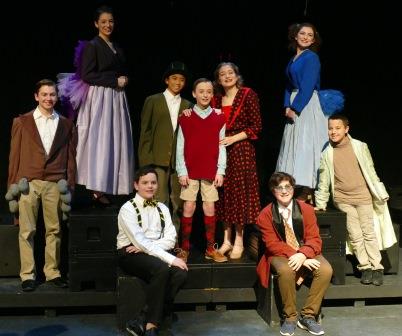
AFYP student cast


CAllen: Is there anything else you’d like our community to know about you, AFYP, the Academy, or the importance of the arts?

MLechter: Just that I feel extremely grateful for the experiences I’ve had, and the people I get to work with. I appreciate having work that means so much, on a daily basis. Now, more than ever, we need arts education. The arts have the potential to teach students of all ages compassion, empathy, sustained focus. It’s easy to become disconnected with everything that vies for our attention in today’s world, and the arts give us a chance to connect in meaningful ways.

Oh. And I love my dachshunds! [laughs]


Mary Lechter's puppies


Thanks to Mary for sharing these wonderful insights and reflections on the past 10 years (and more). Sign up for one of our popular Summer Acting Camps to get the full MCAA/ AFYP experience!


Categories
Announcements

Gather ‘Round The Celebration Tree

WRITTEN BY MORGAN JOHNSON

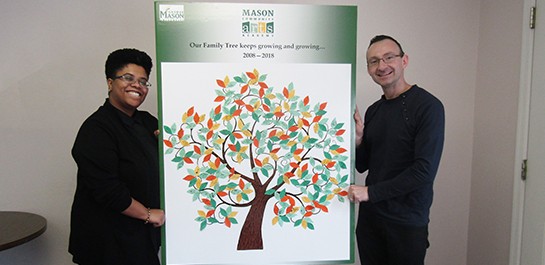
In celebration of our 10-Year Anniversary, the Academy held a celebration event in Mason’s Center for the Arts on Sunday, February 4th. Part of that event was the unveiling of a special “Family Tree”, representing the many people that have been affected positively by Academy programs and have contributed to its success. Students, faculty and staff wrote short and encouraging comments on each of the colorful leaves, celebrating their love of the arts.

Academy Director Libby Curtis spearheaded the project and personally attached every leaf to the Family Tree. “This tree is a great visual snapshot of our growing family,” said Ms. Curtis.“It is a perfect celebration of the positive impact that the Academy has had on the community over the past decade.”

Comments on the leaves varied widely. Some students wrote “Violin is the best!” and “My instructor is the greatest!”, while others wrote “I love Roxy!” (referring to Roxy the certified therapy dog who greets students each week in the office).

Our Family Tree is currently located in Unit A-2 of our Academy Building. Feel free to stop by and see it. As full and beautiful as it is now, we look forward to 10 more years of service and additions to our growing tree!


Categories
Announcements

Celebrating 10 Years: Michelle Richardson

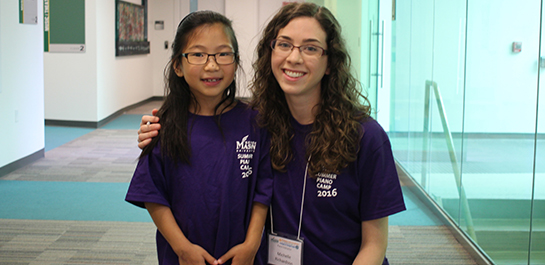
As we reflect on the last ten years, Faculty Coordinator Claire Allen sat down with Piano Teaching Artist Michelle Richardson, who has been with the Academy almost since the very beginning. Michelle, who completed her Bachelor’s and Master’s degrees at Mason’s School of Music and is in the process of completing her Doctorate, has also built a thriving piano studio, created the structure and curriculum for our popular Piano Beginnings children’s classes, and developed two summer programs for young pianists of varying ages and levels – Summer Piano Adventures and Mason Summer Piano Academy.


CAllen: How did you first fall in love with music?

MRichardson: I grew up in a family surrounded by music. While my parents did not play instruments, my mother has a beautiful voice and always sang a lot around the house. My paternal grandmother was a pianist and my aunt was a concert pianist who pursued a degree at Juilliard before she decided to become a lawyer. All of these things combined with inspiring teachers created a musically encouraging environment. I remember specifically learning Chopin Preludes when I realized the potential for beautiful sound and harmonies on the piano. It was love at first sound!


CAllen: What made you decide to pursue music as a career, and how did you choose Mason as your college and graduate school?

MRichardson: Music was a strong interest of mine, although I was equally strong academically and originally was going to pursue my strengths in those areas. When I realized I would regret not studying music more than anything else I could study, I wanted to give it my best shot and see where my passion for it led me. I decided to pursue performance piano and choral music education in my undergraduate degree. Throughout the years, with lots of hard work, I continued my studies into graduate school where more doors were opened for me to build a musical career.


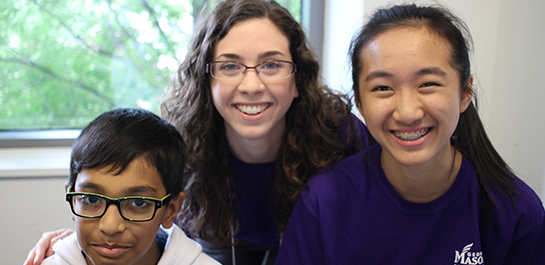
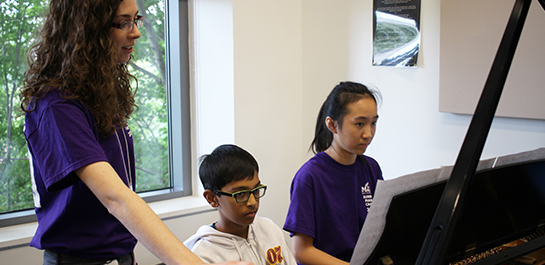
Michelle Richardson with Piano students


CAllen: When did you first hear about Mason Community Arts Academy – formerly known as Potomac Arts Academy?

MRichardson: I was recommended to the Academy by a professor at Mason and decided to join it!


CAllen: You’ve been a driving force behind the shaping of our piano programs for young kids, including the group piano classes and summer piano academy. Can you tell me about your inspirations for each of those programs and what makes them special?

MRichardson: Piano is predominantly learned and performed as a solo instrument, which creates an isolated environment for young students. Despite the hours of alone time, pianists actually are also very social, and if you get a bunch of us together, we have a blast! So my goal has been to foster opportunities that get pianists together to play and learn music while making friends in an otherwise isolated and competitive field. After attending camps together, some of my students still keep in touch through what they tell me is Instagram and Snapchat. [laughs]


CAllen: What did your piano studio and classes look like initially, and how does that compare to what it looks like now?

MRichardson: I have taught privately for over 10 years and at the Academy for over 5 years. The beginning always starts small, but with time and experience your student base grows. I did this by fostering a “musical culture.” By encouraging masterclasses, recitals, chamber playing and offering camps, students have opportunities to enjoy the full spectrum of music making and see its benefits beyond just weekly lessons. My job is to teach students music’s great value not only for a fantastic performance, but beyond for enriching their life. Music becomes a part of their life that they will always seek out even amongst other activities.


CAllen: What is your favorite part of your job, currently?

MRichardson: I truly love teaching music, piano happens to be my vehicle for that. My favorite moment is when suddenly, I find myself just sitting back and listening to my student. I watch them being comfortable enough at the instrument to make beautiful sound, and listen to them using the music score as the basis for their expressive intentions. This combines effort from so many angles: the tradition of great composers and performers whom we love, my own teachers and myself, the student and their own unique voice. The continuity of teaching music and beauty to others is tremendously fulfilling.


CAllen: What is one of the most memorable experiences you have had as a result of teaching for Academy?

MRichardson: My favorite experience is running the Summer Piano Academy. It had been a dream of mine for a long time. I remember the first year we ran the camp, I was so nervous about its success! We had such a blast with students and also with the other teachers who are some of my dear friends and colleagues. This past year’s camp we had my teacher from Mason, Dr. Anna Balakerskaia, participate in a master class for our students. Watching my amazing teacher/ mentor teach some of my students was truly a dream come true! Having been part of making that moment happen gave me so much joy!


Michelle Richardson with Piano student


CAllen: How do you balance being a faculty member with the Academy and a Doctoral student at Mason?

MRichardson: That is a good question! I have also embarked on the journey of motherhood recently, so now I will balance faculty member, doctoral work, and a baby! I have always reminded myself to do the best work I am able to. Doing my own best work sometimes means choosing what work not to do as well, in order to preserve your own quality. This is not easy since as a musician, it is very common to overextend oneself in so many musical avenues. I have tried to seek a balance in taking the best opportunities rather than simply all of them. Even if that means to take an extra semester or year to allow myself some breathing room for practicing, coursework, and professional work. I also have to remind myself that this is not a race, but a marathon! Music will be my lifelong pursuit, so it’s important to take the long term view, and relax and take care of yourself.


CAllen: If you had one wish for how Mason Arts continues to grow in the next ten years, what would it be?

MRichardson: I dream of Steinway grand pianos in every room, but I don’t think they would all fit! I can’t think of a single big change; I’m truly happy with where the Academy has gone over the past five years that I’ve been here! I simply envision a continuation of all of what we do on higher levels: integrating musical value and life in the community in deep and meaningful ways.


A big thank you to Michelle for all of her dedication to the Academy throughout the years! Come and try one of our piano programs and get the “Academy experience”!


Categories
Announcements Community Outreach

Academy Named An NEA Grant Partner

We are proud to announce that we are partnering with the newly formed Mason Arts Research Center (MasonARC) to participate in a National Endowment for the Arts grant funded project researching how arts participation affects child development. The center’s focus will be on theater, dance, music and the visual arts.

MasonARC is co-directed by Thalia Goldstein, Assistant Professor of Applied Developmental Psychology; Adam Winsler, Professor of Applied Developmental Psychology; and Kim Sheridan, Associate Professor of Educational Psychology. The Mason Community Arts Academy’s many arts-based programs will provide the perfect setting for this kind of research.

To learn more about MasonARC and this research project, see the article on News at Mason.