Mason Community Arts Academy
Categories
Community Outreach Instruments in the Attic

Glen McCarthy Shares Passion for Music at Sandals

Categories

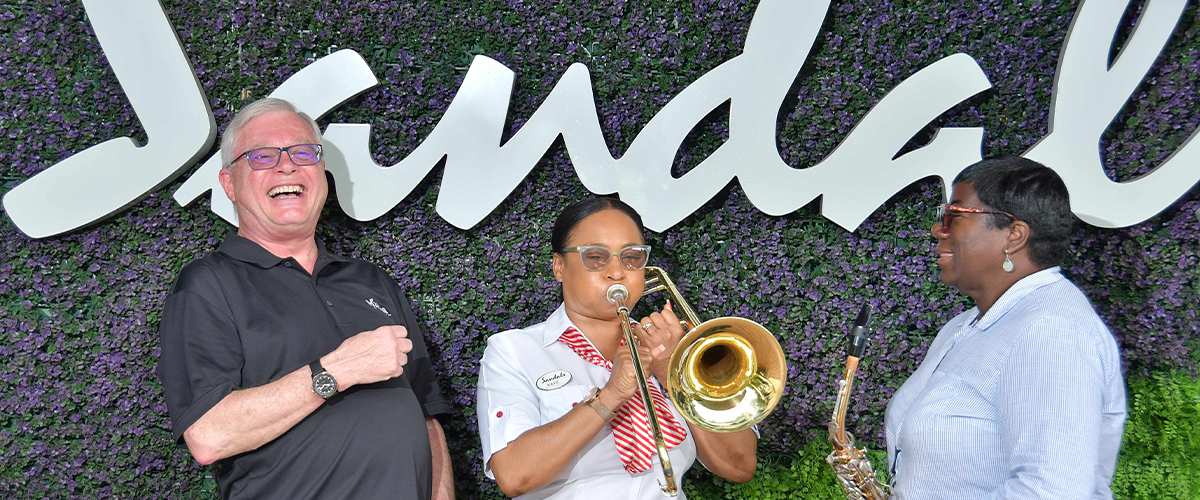
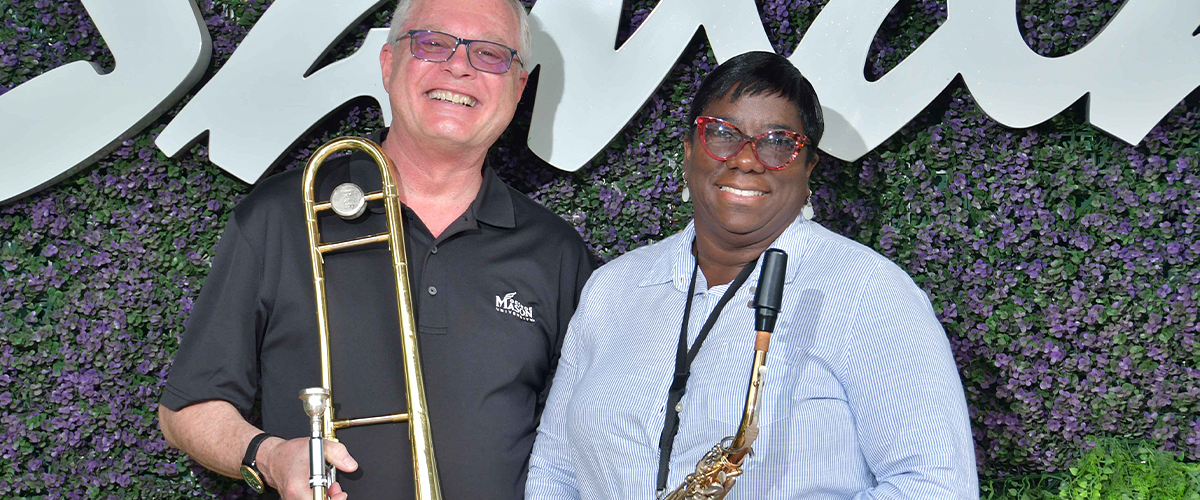
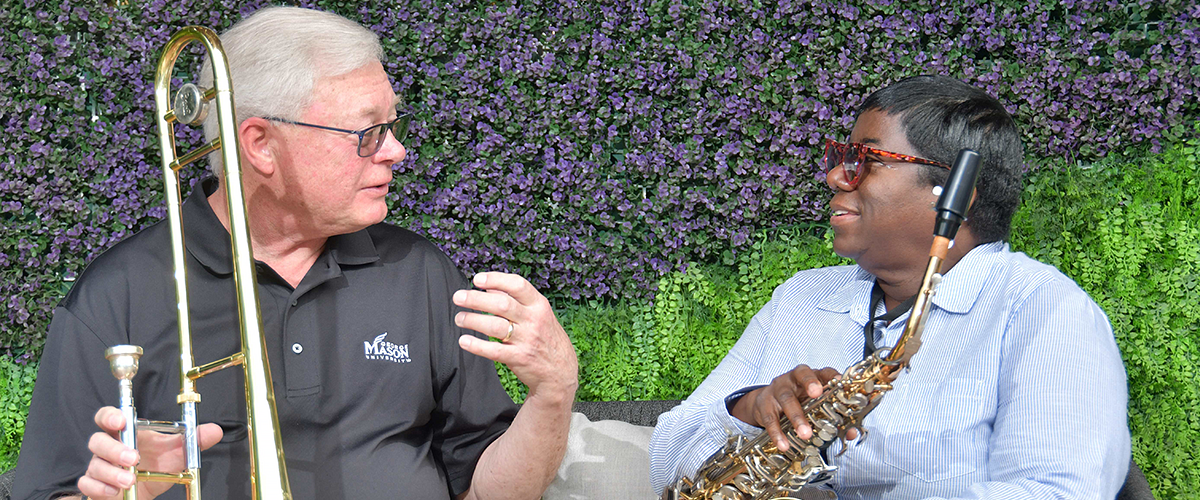
MCAA guitar teacher, Glen McCarthy was generous enough to include Instruments in the Attic (IiA) on his vacation to Sandals, Jamaica over winter break. 

This is not the first time that Mr. McCarthy donated an instrument on IiA’s behalf. Not only has he brought other instruments to the Sandals Foundation as a part of his travels, but Mr. McCarthy regularly facilitates donations to school music programs throughout the Northern Virginia area. 

Our Today writes:

Glen McCarthy, a music teacher at Mason Community Arts Academy, and Dionne Reid-Richards, a project manager in the technical division at Sandals Resorts International, both share a common passion for music and a commitment to imparting this love through music education.

With the help of the Sandals Foundation and Mason Community Arts Academy’s Instruments in the Attic
programme, they are set to achieve just that with the recent donation of musical equipment to the Calvary Wind Ensemble, based at the Calvary Baptist Church in Montego Bay.

Our Today

You can learn more about the story in the link above. MCAA thanks Glen for continuing to support music education and outreach not just here in the Northern Virginia area, but around the world.
Categories
Faculty News

Faculty Enrichment Fund Awardee: Dr. Nina Kiken

Categories

The Academy values the importance of our teacher’s professional development. The Faculty Enrichment Fund annually provides partial and full reimbursement for teachers to attend conferences, workshops, and teacher training sessions. 

Our viola/violin teaching artist, Dr. Nina Kiken, attended a Suzuki pedagogy course:

“This fall I participated in a pedagogy course centered on teaching Suzuki Book 3. Thanks to the support of the Faculty Enrichment Fun, I was fortunate to study with Suzuki Teacher Trainer David Strom, from the Northern Virginia Suzuki Music School. In class, we studied the repertoire in Suzuki Book 3, learning about the new techniques introduced in each piece, and methods to teach more advanced bow strokes, left hand facility, and nuanced musical ideas. More broadly, classroom conversations focused on building interpersonal skills amongst the teacher, student, and parents, in order to create a supportive learning environment.  

The class facilitated a community of teachers, where we could reflect on our own teaching and seek advice on particular challenges incurred in our private studios. The weekly discussions were a great reminder of why we study music: to build self esteem and independence, access beauty, and allow for freedom of expression both with and away from the instrument. Over the duration of the course, I observed eight hours of Strom’s lessons in his private teaching studio. In this component of the course, I saw how intentional language can greatly affect lesson dynamics. I also appreciated the necessity for creativity and flexibility in order to best connect with each student. 

The Suzuki Book 3 course was such an energizing opportunity to think critically about my own teaching and revisit pedagogical ideals I studied in school. I liked it so much that I’m currently enrolled in the Suzuki Book 4 certification!”

Written by Dr. Nina Kiken
Edited by Regina Schneider

Categories
Community Outreach Instruments in the Attic

I.C. Norcom High School Instrument Donation

Categories

Derik J. Wright (pictured to the far left), joins the MCAA family as the Assistant Coordinator of Instruments in the Attic. Mr. Wright had the opportunity to fill some instrumental needs at his previous employer I.C. Norcom High School in Portsmouth, VA, where he served as band director for several years. I.C. Norcom is the 2nd oldest historically African American High School in the nation. The Academy donated 3 trumpets, 2 alto saxophones, 5 clarinets, and 3 flutes.

“The Instruments in the Attic program holds a special place in my heart. Coming from teaching in a Title I school, one of my biggest hurdles was inventory. I simply would not have enough instruments for all of my students and they would have to share. This program puts unused instruments in the hands of students who not only need them but will put them to good use.”

Derik Wright

Mr. Wright is currently studying Wind Conducting under Dr. William Lake Jr. (Mason Summer Band Camp & Summer Conducting Symposium Director) at George Mason. He holds two degrees from Norfolk State University in Music Media (B.M) and Music Theory & Composition (M.M). 

Written by Derik J. Wright

Edited by Regina Schneider

Categories
Faculty News

Playing & Teaching the Saxophone

Categories

Ariel Williams, Academy Assistant Coordinator of Programs and Saxophone Instructor since 2017, had the opportunity to contribute to the development of a newly published saxophone method book, Playing & Teaching the Saxophone: A Modern Approach. While she was studying for her master’s degree in classical saxophone performance at the University of Tennessee-Knoxville, Ariel worked alongside authors Dr. Allison Adams and Brian Horner to create and edit the graphics for the musical examples in the book.

“I was Dr. Adams’s graduate teaching assistant as they were completing the book, and it was wonderful to be able to play a small part in the development of this fantastic new resource in modern saxophone pedagogy.”


Ariel

According to the publisher, Oxford University Press, “Playing & Teaching the Saxophone: A Modern Approach provides a method for teaching the saxophone that is specific enough to use as a textbook in a collegiate saxophone methods class, simple enough for band directors to use in guiding their saxophone sections, clear enough for adult beginners to teach themselves the instrument, and deep enough for professionals to use as a resource in teaching private lessons at any level.” The book is available from the publisher as well as through Amazon.

Edited by Regina Schneider

Categories
Faculty News

Faculty Enrichment Fund Awardee, Dr. Radina Dosseva

Categories

The Academy values the importance of our teacher’s professional development. The Faculty Enrichment Fund annually provides partial and full reimbursement for teachers to attend conferences, workshops, and teacher training sessions. 

Our piano and theory teaching artist, Dr. Radina Dosseva, attended the Workshops in Music Theory Pedagogy in June:

The University of British Columbia in Vancouver (photo by arts.ubc.ca)

I am very grateful to the Mason Community Arts Academy for their support and encouragement of their teachers to pursue professional development opportunities. The Faculty Enrichment Fund Award allowed me to finally fulfill my dream of attending the Workshops in Music Theory Pedagogy on the beautiful campus of The University of British Columbia in Vancouver, Canada, this June. 

This week-long immersion in music was the perfect way to network with other like-minded musicians and dedicated teachers from all over the world. The first workshop was held in 2007, and the conference has taken place every three years since then. I was fortunate to have met the two co-directors of the workshops, professors Leigh VanHandel (University of British Columbia) and Gary Karpinski (University of Massachusetts-Amherst).

I got to know the other amazing presenters, professors Nancy Rogers (Florida State University), Jena Root (Brown University), Jenny Snodgrass (Lipscomb University), and Michael Callahan (Michigan State University). I made many new friends from all over the US and Canada, and had the pleasure of being introduced to another professor at the University of British Columbia, Laurel Parsons, who teaches music theory, aural skills, and film music analysis. Everyone at the conference was incredibly kind and willing to share all kinds of pedagogical information with other attendees.

New friends from all over the US and Canada

I learned about fun technology to incorporate into the classroom, like Kahoot and Artusi music. I learned new ways of using musical dictation and improvisation/composition exercises when teaching aural skills. Many of the discussions revolved around aural skills acquisition and how important it is to develop a strong ear in order to become a well-rounded musician.

I learned about very interesting and new (to me) ways to analyze music, such as the Nashville Number System used in commercial music. Many session musicians and background singers have not heard the music before recording it. They are usually handed a lyric sheet at the sessions and have to quickly map out the melody line because they might only hear the music once before having to perform it. They need to have excellent aural skills and so they use the Nashville Number System as a shorthand to write down the scale degrees on which each chord of the song is built. They use numbers instead of Roman numerals to quickly create simple chord charts that help them navigate the song during session recordings.

In addition to all the musical knowledge I gained, I was also fortunate to be immersed in another culture. The Canadian people I met were extremely polite and nice. Young people would always give up their seat on the bus for elderly passengers. They would also stop their cars immediately, if they thought a pedestrian might be thinking of crossing the road.

I learned that the Indigenous people of the area, in particular the Musqueam, are a big part of university life and have a dedicated academic building on campus, called the First Nations Longhouse. We had important discussions on how to expose our students to the beautiful Indigenous music, while being mindful of not appropriating another peoples’ culture in the process. I was able to see many wooden sculptures and totem poles, and I got to hear a concert of Indigenous music on July 1st, Canada Day.

Words cannot describe the breathtaking beauty of the campus, with its giant fir trees and other native plants, as well as the serene views of the mountains and the ocean across the horizon, visible directly from campus, which also overlooks a stunning rose garden right next to the Chan Centre for the Performing Arts.

Concert of Indigenous Music

This conference taught me many new concepts, helped me rethink my teaching philosophy, and gave me new pedagogical ideas to incorporate into my private and group teaching. It also gave me a renewed sense of cultural awareness and helped me make a lot of new friends, who inspired me. It was a very refreshing and invaluable experience, and I am very grateful to Mason Community Arts Academy for making it possible. 


Written by Dr. Radina Dosseva
Edited by Regina Schneider